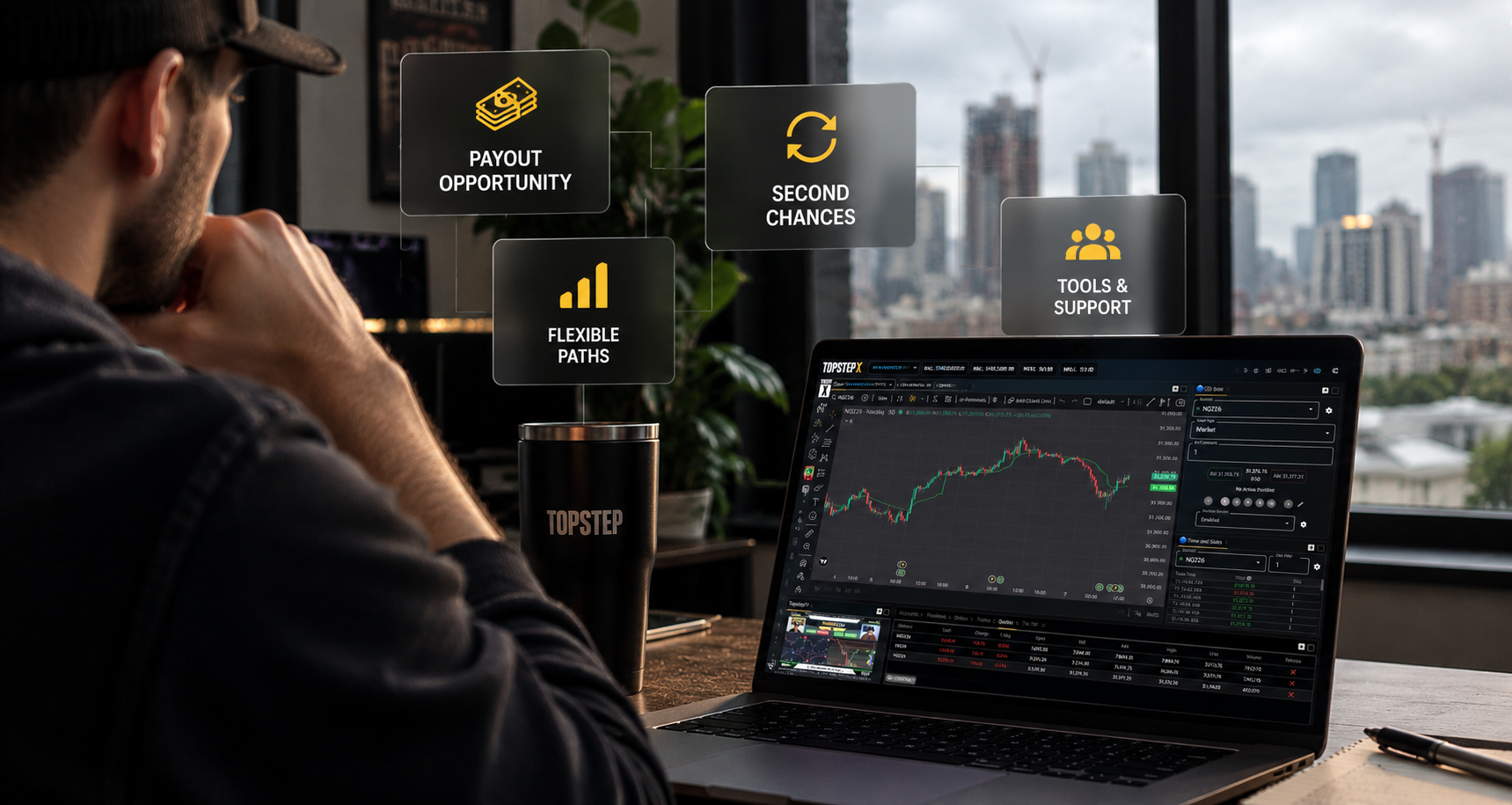
A prop firm, or proprietary trading firm, lets traders access the firm's capital under set risk rules in exchange for a share of any profits. Most futures prop firms, including Topstep, require traders to pass a paid evaluation in a simulated account before trading a funded account.
Key facts
- How it works: evaluation, then funded account, then payouts under a profit split.
- What you risk: the evaluation and activation fees, which are not refundable.
- Typical rules: a maximum loss limit, an optional or required daily loss limit, and a profit target.
- Topstep example: traders keep 90% of profits in an Express Funded Account, per the payout policy, as of Oct 12, 2026.
What is a prop firm?
A proprietary trading firm (commonly called a prop firm) provides traders with access to its own capital for trading, sharing profits based on performance. Instead of risking your life savings for your trading goals, prop firms let you purchase an evaluation where you can prove your skills and focus on performance. When you win, prop firms like Topstep will allow you to keep up to 90% of the profits. You bring the skill. They bring the capital.
Evaluation and activation fees are not refundable. Most Trading Combines are not completed (16.8% were in 20251).
The term covers two models. Institutional prop desks trade the firm's own money with employees. Evaluation-based retail prop firms, which describe most futures prop firms today, let traders pay for an evaluation and then trade a funded account for a profit split. This guide covers the second kind.
For beginners, a prop firm can be one of the best ways to build real trading experience and grow potential profits without needing a large personal bankroll. But it's not just about funding. The right prop firm helps you build discipline, manage risk, and trade within a structured environment. For example, Topstep has built a system and community that supports those habits at every step.
Why do prop firms exist?
Traders used to have to risk their life savings to learn to trade. By trading at a prop firm, you can build the habits and discipline needed to be successful in the markets without going "all-in." You can experience the emotions of winning and losing BEFORE putting your hard-earned money at risk.
How does a prop firm work? (With Topstep as your example)
Here’s how it works, with Topstep as your first and best example:
Step 1: Pass an evaluation (Topstep's Trading Combine®)
This first step is known as a prop firm evaluation, where you prove your skill in a simulated environment. At Topstep, this happens in the Trading Combine®, a real-time, simulated evaluation built to test your trading skills, not your luck.
The rules are clear: hit the profit target, stay within your maximum loss limits, and show consistency. If you break a rule, you can reset and try again; a reset has its own fee.
Step 2: Earn a Funded Account
Pass the Trading Combine and become a funded trader through Topstep's Express Funded Account.
The Express Funded Account (XFA) is a Funded Evaluation. You can manage up to five Express Funded Accounts at once, and the rules are the same; steer clear of the Maximum Loss Limit, but now the profits are real. Yeah, you read that right: simulated trading, with real profits.
Step 3: Request payouts under a profit split
A payout is a withdrawal of profits from a funded account, and the profit split is the share of those profits you keep. Traders who meet the program rules can request payouts under the published payout policy. On the Standard path, a first payout request needs 5 winning days of $150 or more. Processing time depends on the payout method, after an internal approval that can take 1 to 3 business days. Figures as of October 12, 2026.
What are the types of prop firms?
Prop firms fall into three common types based on how a trader gets access to capital: evaluation-based, instant funding, and live capital. Futures prop firms trade exchange-listed contracts, like ES and NQ on the CME, through evaluation programs.
Topstep is an evaluation-based firm. For a closer look at the instant funding model, read our guide to instant funding in prop firm trading.
Why futures prop firms?
A futures prop firm specializes in trading futures contracts. Futures are standardized agreements to buy or sell something (like oil, gold, etc.) at a set price on a specific date in the future. That might sound complicated, but futures trade a lot like stocks, except you can trade them nearly 24 hours a day, and you can take either side of the market: a long position gains if the price rises, and a short position gains if it falls. Either position can also lose money.
How do prop firms make money?
Evaluation-based prop firms make money from evaluation fees and from their share of trader profits. Fees come from every trader who buys an evaluation, whether or not they pass. The profit split applies only when a funded trader has profits and requests a payout.
How does Topstep work? A worked example
Topstep follows the three-step path as a Trading Combine®, then an Express Funded Account (XFA), then a Live Funded Account. Here are the parameters, with a source for every number.
Step 4: Keep going, keep growing
The journey doesn’t end there. At Topstep, the goal isn’t just to get you funded; it’s to help you become the kind of funded trader who can stay funded, take consistent payouts, and keep leveling up. Stick to what got you there, and show you’re ready for a Live Funded Account, and our Risk Team may call you up. Call-ups are decided case by case, based on factors like consistency, risk management, and payout history, per the Live Funded Account call-up process.
Step 5: Thrive in Live
It’s not called the Big Leagues for nothing. These traders have earned their spot through a Risk Team review, and Topstep backs them with a Live Funded Account, which starts with a tradable portion of the account and holds the rest in reserve, per the Live Funded Account parameters. You’re trading in real markets, with no profit targets, and you keep 90% of the profits.
Start Trading · Not ready yet? See how the program works.
What are the key prop firm rules to know?
Six terms cover most of what a beginner needs to read in a prop firm’s rules. For a deeper look, see prop firm drawdown rules.
Maximum Loss Limit
A Maximum Loss Limit is the lowest your account balance can fall before the account fails. At Topstep, the limit trails your highest end-of-day balance and locks once it reaches your starting balance. It is $2,000, $3,000 and $4,500 for 50K, 100K and 150K accounts. Maximum Loss Limit explained, as of October 12, 2026.
Daily Loss Limit
A Daily Loss Limit is the most an account can lose in a single trading day before trading stops for that day. At Topstep it is optional in the Trading Combine and Express Funded Account, set at $1,000, $2,000 and $3,000 for 50K, 100K and 150K accounts, and automatic in the Live Funded Account. Daily Loss Limit explained, as of October 12, 2026.
Profit target
A profit target is the amount of profit an evaluation requires before you can pass it. Topstep's Trading Combine targets are $3,000, $6,000 and $9,000 for 50K, 100K and 150K accounts, per the Trading Combine parameters.
Consistency target
A consistency target is a rule that limits how much of your total profit can come from a single day. At Topstep, the Trading Combine's target is 55%, and the Consistency payout path in an Express Funded Account uses 40%. Consistency at Topstep, as of October 12, 2026.
Profit split
A profit split is the share of funded-account profits the trader keeps. Topstep's is 90% to the trader and 10% to Topstep, per the payout policy, as of October 12, 2026.
Payout
A payout is a withdrawal of profits from a funded account, subject to the firm's payout policy. At Topstep the minimum payout is $125. See the payout policy for caps and processing times.
What does a prop firm cost?
A prop firm costs an evaluation fee, and sometimes an activation fee once you pass and a reset fee if you start over. Evaluation and activation fees are not refundable.
Prices change, so confirm them on the Trading Combine page before you decide.
How do you choose a prop firm?
Choose a prop firm by checking how clearly it states its rules, fees, and payout process before you pay.
Checklist
- Rules transparency: the profit target, loss limits, and consistency requirements are published, specific, and dated.
- Payout policy: the minimums, timing, and profit split are written down and easy to find.
- Platform: you can trade on a platform you are willing to learn.
- Regulation of the broker: find out which broker or clearing firm holds the accounts and whether it is regulated.
- Support: you can reach a person when a rule or a payout is unclear.
- Community: there are resources for learning the rules and managing risk.
Red flags
- Unclear rules: terms that are vague, buried, or different in different places.
- Rule changes without notice: conditions that shift after you have paid.
- Payout delays: no stated timing for payouts, or stated timing that is not met.
Is a prop firm right for you?
If you are looking to build real trading experience with structure, support, and resources to help you sharpen your skills, a prop firm might be right up your alley. It is not a fit if you cannot afford to lose the fees, since fees are not refundable and most evaluations are not completed.
Here are Topstep's published 2025 progression statistics1:
But not all prop firms are built the same.
If you’re looking for a futures prop firm, Topstep offers structure, support, and resources. You'll have access to TopstepX, a futures trading platform built by traders, for traders. TopstepTV makes sure you're never trading alone, and you've got good company while you're at it. There's a help center with details on top of details if you ever have a question, and there are real people on the Support Team that you can call if you can't find an answer.
If you're ready to really make progress in your trading journey, Topstep is where you want to be.
FAQs about prop firms
What is a prop firm in trading?
A prop firm is a company that gives traders access to its capital under set risk rules, in exchange for a share of any profits. Most futures prop firms require traders to pass a paid evaluation first.
How does a prop firm work?
A prop firm works in three steps: you pass an evaluation, trade a funded account under risk rules, and request payouts under a profit split. At Topstep, the evaluation is a simulated program called the Trading Combine®, where participants must meet profit targets, stay within loss limits, and show consistent performance. No real money is at risk during this phase, only the evaluation fee.
How do prop firms make money?
Evaluation-based prop firms make money from evaluation fees and from their share of profits when funded traders have profits. Fees are paid whether or not a trader passes.
What are the disadvantages of prop firms?
The main disadvantages are that fees are not refundable, the rules are strict, and most evaluations are not completed. Topstep's 2025 figures show 16.8% of Trading Combines were completed. Read the rules and fees before you pay.
What happens if you lose a prop firm's money?
If an account reaches its Maximum Loss Limit, the account fails and the Trader doesn't owe the losses beyond fees paid. If you break another rule, the attempt can end too, and you can reset for a fee, so read each rule first.
How much does a $50K prop firm account cost?
Cost depends on the firm and the plan. At Topstep, a 50K Trading Combine is $49 a month on the Standard plan, plus a $149 activation fee after you pass, or $95 a month with no activation fee, per the pricing page, as of October 12, 2026. Fees are not refundable.
Are prop firms legit?
Prop firms can be legitimate. Reputable prop firms like Topstep are well-established and operate transparently, offering traders access to capital without risking their own savings. Check any firm for published rules, a clear payout policy, and support you can reach. See is Topstep legit.
What is the difference between a prop firm and a broker?
A broker executes your trades in an account that holds your own money. A prop firm gives you access to its capital under its rules, usually after an evaluation, and shares profits with you.
1Based on both simulated and live trading internal data of Topstep's 2025 Trader Performance Statistics (January-December 2025), found on Topstep’s Website, as of October 12, 2026. Past performance is not indicative of future results.
*As of October 12, 2026.