

Most traders don’t think about hedging… until they accidentally do it.
You place a trade. Then another in the opposite direction on a different account, leaving you long and short at the same time.
Feels like you’re covered, right? Not exactly.
That’s hedging. And in prop futures trading, it’s not something you can rely on, especially if your goal is to trade in a Live Funded Account with Topstep’s® money.
At Topstep, we don’t just enforce the rules. We help you understand them.
Because one of the biggest advantages you can have as a trader is knowing what not to do.
What is hedging in trading?
Hedging in trading is when you open opposite positions in the same market to try to reduce risk.
At Topstep, hedging occurs when a trader holds opposite positions across different accounts in the same market (or certain correlated markets) to try to reduce risk. Hedging is tracked at the user level, not the account level.
In simple terms, hedging is:
- You go long (buy) a market in one account
- Then you go short (sell) that same market in a different account
The idea is to protect yourself if the trade goes against you.
Not every position adjustment is considered hedging, though. The issue isn't managing a trade inside one account. It's creating opposing positions across different accounts that cancel each other out.
And in some areas of finance, like portfolio management, hedging has a place. But in prop futures trading, especially at the individual trader level, it doesn’t work the way most people think.
Instead of taking a loss or letting a trade play out, hedging can trap you in a position where nothing moves forward. And in real brokerage accounts, this kind of behavior is often restricted.
Why you can’t hedge at Topstep
Topstep is designed to help traders develop real trading skills and prepare for trading in Live markets.
If you can profit no matter which way the market moves, you’re not proving your ability to read the market, manage risk, or execute a strategy. You’re bypassing it.
And in Live markets, that doesn’t fly.
Exchanges like the Chicago Mercantile Exchange (CME) closely monitor trading behavior to make sure it reflects real market risk and competition.
Using hedging to:
- Trade against yourself across accounts
- Offset positions to avoid risk
- Coordinate trades that lack clear or true market intent
can fall into categories like wash trading or non-competitive behavior, which are restricted in Live markets.
So while hedging might seem like a workaround in a simulated environment like Topstep’s Trading Combine®, it’s not something you can carry into real trading. That’s why hedging isn’t allowed at Topstep.
The hedge warning: one more way Topstep has your back
In Topstep’s exclusive trading platform, TopstepX, if you try to place a trade that creates a hedge, you may see an in-app warning and, in some cases, a countdown to resolve it.
That’s not just there to stop you. It’s there to help you.
It’s a moment to pause and ask:
- What’s my plan here?
- Am I managing risk or avoiding a decision?
- What would I do in a real funded account?
If you’re long, you should have a reason. If you’re short, you should have a reason.
But being both at the same time in different accounts? That’s not a strategy. The goal isn't to catch traders breaking rules. It's to help them build habits they can carry into Live markets.
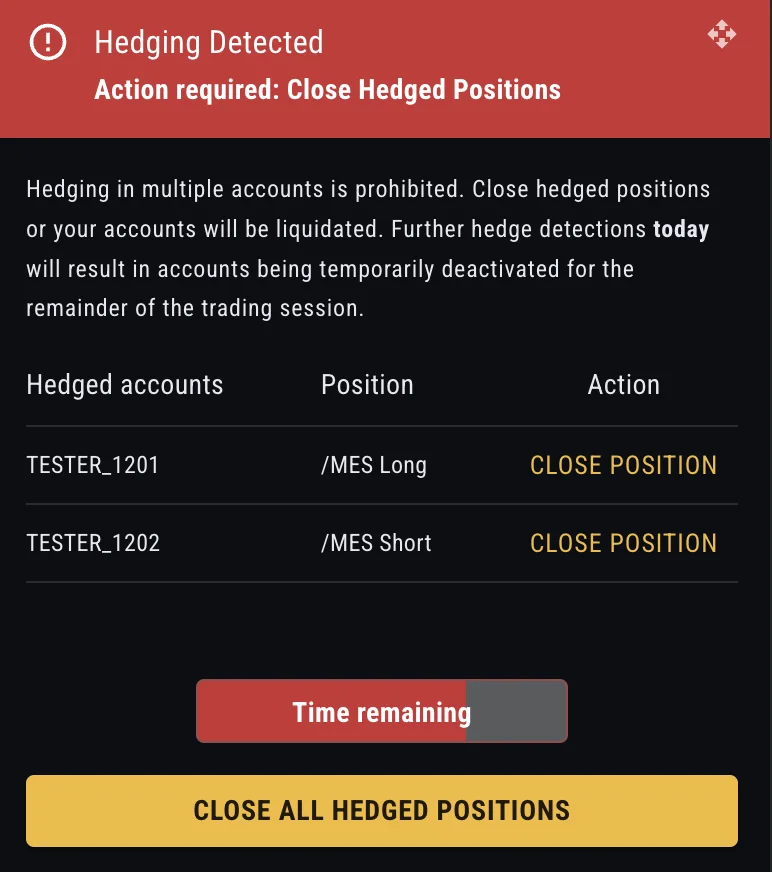
A TopstepX hedge alert showing opposite positions across multiple accounts in the same market.
Built to protect traders, not just enforce rules
Everything in TopstepX is designed to help you get funded and stay funded.
That means:
- Success reflects genuine trading skill
- All traders compete on a level playing field
- You're prepared for the rules you'll face in Live markets
- Topstep’s capital is allocated to skilled traders, not loophole exploiters
The hedge warning is just one example. It’s not about restriction. It’s about preparation.
Because the traders who succeed aren’t the ones who avoid losses entirely. They’re the ones who manage risk, make decisions, and have the mindset to stay consistent over time.
That’s one more way Topstep has your back.
Frequently asked questions
What is hedging in trading?
Hedging is when you open opposite positions to try to reduce risk. At Topstep, hedging occurs when a trader holds opposite positions across different accounts in the same market. For example, being long in one account and short in another at the same time.
Does the TopstepX platform allow hedging?
No. Hedging isn’t allowed on TopstepX. If hedging occurs, you may see a pop-up warning and, in some cases, a countdown to resolve it. It’s there to help you slow down, think through your plan, and build habits you can carry into Live markets.