

Week 39: The Fed Finally Hikes, Bitcoin Shrugs Off a Failed Vote, and Oil Eases on Hope Rather Than Peace
KEY TAKEAWAYS
- The FOMC hiked 25bp to 3.75-4.00% Wednesday — its first hike since 2023 — on a UNANIMOUS 12-0 vote, with a genuinely hawkish dot plot (16 of 18 officials see at least one more hike this year) and the shortest Warsh press conference since 2011. The Bank of Japan also hiked, to a 31-year high of 1.25%, but on a split 7-2 vote with two dissenters preferring to hold — a dovish tell that sent the yen weaker, not stronger. The Bank of England held this week. ‘Synchronized tightening’ is real but uneven, and the Dollar Index crossed 100 for the first time in seven weeks on the Fed move alone.
- Crude eased for a third straight session, but not because Hormuz calmed down: Monday's planned Gulf states-Iran meeting in Oman was POSTPONED (Bahrain refused to attend), and fresh tanker strikes hit the Strait as recently as today. The main driver is Saudi Aramco's East-West Pipeline restoration timeline (targeting ~50% capacity within days after a September 10 drone strike, with full restoration in a base case of ~6 weeks). Refined products didn't care either way — RB and HO remain within a few percent of fresh 52-week highs on a separate, still-intensifying structural refining shortfall.
- Bitcoin rallied +4.53% despite a week that should have been unambiguously negative: the Senate's CLARITY Act cloture vote FAILED 49-50 Tuesday — Gillibrand, Warner, and Warnock, the three senators this newsletter flagged as the deciding votes, all voted no — and the Fed's hawkish hike two-stepped BTC down with it to a Wednesday low near $76,250. The bounce reflects event-risk unwind and a reversal in spot ETF flows (from a combined -$746M outflow across the two event days back to inflows Thursday), not a dovish surprise — the Fed's guidance was genuinely hawkish.
Data as of September 18, 2026 at 11:45 CST
WEEK IN REVIEW: MACRO CONTEXT
The FOMC hiked 25 basis points to 3.75-4.00% on Wednesday, September 16 — the first hike since 2023 — on a unanimous 12-0 vote; the three hawks who dissented at the July meeting (Hammack, Kashkari, Logan) got their hike this time, and no one dissented in the other direction. The Summary of Economic Projections was genuinely hawkish: 16 of 18 officials see at least one more hike before year-end (median year-end-2026 dot 4.1%), and the 2027 median held at 4.1% as well — a 50 basis point hawkish revision from June, though that vote was described as ‘a fairly close call’ among committee members. Chair Warsh's press conference ran roughly 30 minutes, the shortest since press conferences began in 2011, but still delivered an unambiguously hawkish line: he said he would be ‘hard-pressed to describe broad financial conditions as restrictive.’ Markets reacted more to the 2:30 pm press conference than the 2:00 pm statement itself — the 10-year yield briefly broke above 5% intraday Wednesday before reversing lower Thursday as the initial shock faded, which is why this week's net change across the curve looks modest despite real intraday volatility.
The Bank of Japan added a genuine wrinkle to the ‘synchronized tightening’ narrative Friday, September 18: it hiked to a 31-year high of 1.25%, its second hike this year, but the vote split 7-2, with two reflationist board members appointed by Prime Minister Takaichi preferring to hold. Governor Ueda's language explicitly cautioned against tightening ‘too sharply,’ and the yen actually weakened on the decision rather than strengthening — a split vote reads as a dovish tell even when the headline number is a hike. The European Central Bank had already hiked 25 basis points on September 10, citing Middle East-driven inflation risk — but the Bank of England explicitly did not follow, holding at 3.75% in a 6-3 vote this week (with three dissenters wanting to hike). The clean framing: three of four major central banks tightened this week or last, but the manner and conviction varied meaningfully, and the Dollar Index's crossing of the 100 level for the first time in roughly seven weeks reflects the Fed's own hike more than any uniform global consensus.
Crude oil eased for a third consecutive session into today, but the popular framing — that Hormuz risk is fading — does not hold up under scrutiny. Monday's planned meeting between Gulf Cooperation Council foreign ministers and Iran in Salalah, Oman, intended to discuss a temporary Hormuz shipping arrangement, was postponed outright after Bahrain refused to attend pending restoration of diplomatic ties with Iran; no new date has been set. Fresh tanker strikes hit the Strait again as recently as Friday. Refined products shrugged off both storylines: RBOB and heating oil remain within a few percent of fresh 52-week highs, confirming the structural global refining shortfall (roughly 7-8 million barrels per day of capacity offline across the Middle East and Russia) is a separate, still-intensifying story.
Bitcoin delivered this issue's most counterintuitive move: +4.53% on the week despite a resolution that, on paper, should have been unambiguously bad news. The Senate's CLARITY Act cloture vote failed 49-50 on Tuesday — Senators Gillibrand, Warner, and Warnock, the three this newsletter had flagged as the deciding votes, all voted no, ending comprehensive crypto market-structure legislation prospects in the Senate for the remainder of 2026. BTC fell as much as 5.3% on the news to a weekly low near $76,250, then absorbed the Fed's hawkish hike the next day before beginning a genuine, volume-confirmed recovery Thursday and Friday. The most coherent explanation is an event-risk unwind, not a dovish surprise — the Fed's guidance was hawkish, not dovish — combined with a reversal in spot ETF flows from a combined roughly -$746 million outflow across the two event days back to net inflows once both events had cleared.
Data as of September 18, 2026, around 11:45 CST
RATES & DOLLAR (ZT/ZN/ZB/DX) — SYNCHRONIZED TIGHTENING, UNEVENLY DELIVERED
The FOMC hiked 25 basis points to 3.75-4.00% on Wednesday, its first hike since 2023, and the manner of delivery told its own story: a unanimous 12-0 vote, a genuinely hawkish dot plot (16 of 18 officials project at least one more hike this year), and a Chair Warsh press conference so brief — roughly 30 minutes, the shortest since the format began in 2011.
PRICE ACTION & TECHNICAL STRUCTURE
ZTZ26 (2-year) last traded 101-28.5, down -0.18% on the week, RSI 22.59 (deeply oversold) but ADX only 7.96 — a genuinely weak trend despite the oversold reading, consistent with a market that spiked hard mid-week and then partially recovered.
ZFZ26 (5-year) fell -0.32%, printing a fresh 52-week low (104-03.5), RSI 25.
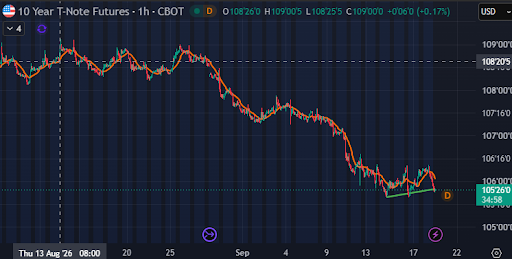
ZNZ26 (10-year) fell -0.29%, also a fresh 52-week low (105-21), RSI 29.15.
ZBZ26 (30-year) actually gained +0.20% on the week, within 0.8% of its own 52-week low (106-01), RSI 39.87 — the least affected of the four, consistent with Thursday's yield reversal disproportionately benefiting the long end.
DXZ26 last traded 100.005, up +1.24% (+$1.22), RSI 63.79, ADX 30.41 (a genuinely strong trend), within 1.3% of its own 52-week high (101.305).
FUNDAMENTAL THESIS
The most important nuance this week is that the modest net weekly change across the Treasury curve masks real intraday volatility: the 10-year yield briefly broke above 5% intraday Wednesday during and after Warsh's press conference — stocks sank toward their lowest levels since July in the same window — before reversing roughly 7 basis points lower by Thursday as the initial shock faded and yields normalized. That round trip is itself informative: it suggests the market's first reaction to the hawkish press conference overshot, and the correction validates a ‘priced in’ read of the actual rate decision.
The 2027 dot plot detail is worth watching closely: the median held at 4.1%, a 50 basis point hawkish revision from June, but the underlying vote was described as ‘a fairly close call’ — 8 officials for another hike, 6 for holding, 4 already looking toward cuts — meaning the committee's own forward view is far less unified than Wednesday's unanimous vote suggests.
The Bank of Japan's split vote adds a genuine complication to any clean ‘global central banks all tightening together’ narrative: two newly appointed reflationist board members preferring to hold, even as headline rates rise to a 31-year high, is the kind of internal dissent that historically precedes a pause.
The Bank of England's outright hold this week (6-3, with the dissenters wanting to hike) is the cleanest evidence that the tightening wave is not uniform: not every major central bank is reading the same energy-driven inflation shock the same way.
CATALYST CALENDAR — NEXT 10 DAYS
WATCH ITEMS
- Post-blackout Fed commentary: the first speeches since the decision will clarify whether ‘one more hike’ is a genuine committee consensus or a headline dot-plot median papering over the same close-call dynamics visible in the 2027 projections.
- Dollar durability: most major bank forecasts still see DXY ending the year well below 100 — a continued push higher into the 101+ 52-week high would be a genuine surprise worth reassessing consensus over.
- BoJ follow-through: watch whether the two reflationist dissenters' preference for a pause gains support at the next meeting — that would be the clearer signal on whether Japan's tightening cycle has more room to run.
ENERGY (CLX26 / RBV26 / HOV26) — EASING ON HOPE, NOT ON PEACE
Crude has eased for a third straight session into today, and the popular view— that Hormuz risk is fading — does not survive contact with this week's actual headlines. Monday's planned meeting between Gulf Cooperation Council foreign ministers and Iran in Salalah, Oman, meant to discuss a temporary Hormuz shipping arrangement, was postponed outright at the request of ‘some regional countries’ after Bahrain refused to attend pending restoration of its own diplomatic ties with Iran; no replacement date has been confirmed.
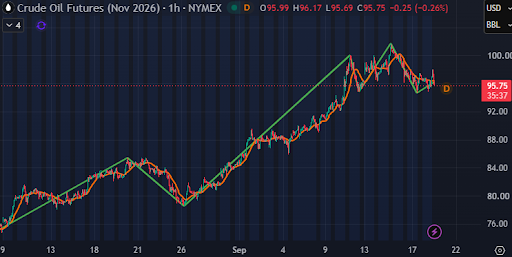
Fresh tanker strikes hit vessels near the Strait as recently as Friday, and Hormuz transit remains near-frozen for normal commercial traffic (roughly 8 transits recorded September 13 versus an 85-per-day pre-crisis baseline). What is driving crude lower is a combination of Saudi Aramco's pipeline-restoration timeline and this week's fresh dollar strength — improving supply-side sentiment and a firmer currency squeezing crude simultaneously, not a resolved conflict.
PRICE ACTION & TECHNICAL STRUCTURE
CLX26 (front month rolled to November) traded a range of $94.83 to $98.01 this week, last $96.10, up a modest +0.85% net (+$0.81) — that small net figure masks real intraweek volatility as the pipeline-restoration headline and dollar strength worked against last week's momentum. Price remains above all four moving averages (MA20 $89.87, MA50 $83.07, MA100 $80.80, MA200 $73.30).
RBV26 last traded $3.4705, up +5.63% (+$0.19), RSI 72.85 (very overbought), ADX 25.79, within 1.8% of its 52-week high ($3.5326).
HOV26 last traded $5.018, up +2.56% (+$0.13), RSI 68.48, above all four moving averages and within a few percent of its own 52-week high ($5.2968). Both refined products effectively ignored crude's pullback this week.
CATALYST CALENDAR — NEXT 10 DAYS
WATCH ITEMS
- Pipeline restoration confirmation (primary): any Aramco update confirming or missing the ‘half capacity within days’ milestone will move crude more than most scheduled data this cycle.
- Rescheduled Hormuz talks: a new date being set for the Gulf states-Iran meeting (or a continued absence of one) is itself a signal on the diplomatic track's health, independent of the pipeline story.
- EIA product builds (Sept 23): a second consecutive week of unexpected gasoline/distillate builds would be the first real evidence the structural refining shortfall is easing — one week alone is not enough to call a trend.
BITCOIN (BTCU26) — A FAILED VOTE, A HAWKISH HIKE, AND A RALLY ANYWAY
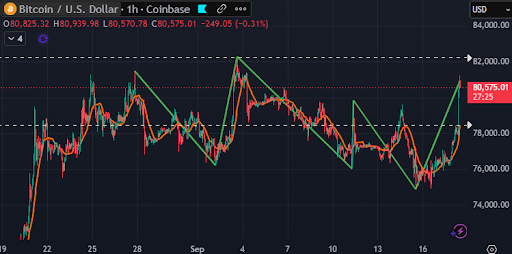
Bitcoin's week resolves two binary events this newsletter has been tracking, and the outcome is a genuine puzzle worth explaining carefully rather than waving away. The Senate's CLARITY Act cloture vote failed 49-50 on Tuesday, September 15 — well short of the 60 votes needed to proceed to floor debate. All three senators this newsletter had flagged as the deciding votes — Kirsten Gillibrand, Mark Warner, and Raphael Warnock — voted no, joining the entire bloc of Democrats who had spent months in bipartisan negotiations. Warner said publicly that Republicans' failure to address the conflict-of-interest concerns around the president's personal financial ties to the crypto industry ‘made it impossible for me to support moving forward,’ despite a revised bill text released two days earlier adding new ethics restrictions. With the Senate and House both entering midterm recess in early October, comprehensive market-structure legislation is effectively frozen until the new Congress convenes in January 2027. BTC slumped as much as 5.3% on the news to an intraday low near $76,250, then absorbed Wednesday's hawkish Fed hike on top of it — before beginning a genuine recovery Thursday and Friday that carried the week to a net +4.53% gain.
PRICE ACTION & TECHNICAL STRUCTURE
BTCU26 traded a range of $76,250 to $81,415 this week, last $81,020, up +4.53% (+$3,511.15) net despite the sharp mid-week decline. RSI at 63.63 and ADX at 31.30 confirm a genuine, not merely technical, recovery — price is above all key moving averages (MA20 $78,505, MA50 $70,495, MA100 $70,784, and above MA200 $76,036).
This contract (BTCU26) expires September 25, one week away.
FUNDAMENTAL THESIS
The single most important framing point: Bitcoin's bounce should NOT be read as evidence the Fed delivered a dovish surprise, because it did not — the dot plot explicitly projects further hikes, and no cuts are projected through 2027. The more defensible explanation is event-risk unwind. Both the CLARITY vote and the FOMC decision were, in different ways, largely priced ahead of time: rate-hike odds had already climbed from roughly 29% to over 50-60% in the weeks before the meeting, and Galaxy Digital's own 10% CLARITY passage estimate meant the failed vote validated rather than surprised the market.
With both binaries resolved, a large IBIT-linked options wall (roughly $6.3 billion notional, concentrated $70,900-$79,700 in BTC-equivalent terms) that had been driving defensive put buying into the events saw those hedges unwind — a classic sell-the-rumor, buy-the-resolved-news pattern.
NOTABLE POSITIONING & FLOW
The ETF flow reversal described above is the clearest, most sourced positioning signal this week. Deribit's 30-day implied volatility index ran around 39% heading into the FOMC — a moderate, not panic-level, reading — with 25-delta skew running modestly in favor of puts for the September 25 expiry, consistent with event-driven hedging demand that should compress now that both binaries have cleared.
CATALYST CALENDAR — NEXT 10 DAYS
WATCH ITEMS
- ETF flow durability: confirmation that Thursday's inflow reversal extends through the Sept 25 expiry window would be the strongest evidence the rally is flow-driven and not merely a short-covering bounce.
- September 25 options/futures expiry: the large IBIT-linked options wall and the BTCU26-to-BTCZ26 roll landing the same day is a genuine source of pin/gamma risk independent of any new catalyst.
- Do not mistake this bounce for regulatory improvement: the CLARITY Act's path forward is now frozen until at least January 2027 — a structurally worse position than two issues ago, even though price has recovered.
IMPORTANT NOTICE — PLEASE READ CAREFULLY
This publication is for informational and educational purposes only and does not constitute investment advice, a recommendation, or an offer or solicitation to buy or sell any futures contract. Futures trading involves substantial risk of loss and is not appropriate for all investors; leverage can work against you as well as for you. Past performance is not indicative of future results. Per CFTC Rule 4.41, any hypothetical or simulated performance results have inherent limitations, do not represent actual trading, are prepared with the benefit of hindsight, and no representation is made that any account will achieve similar profits or losses.
Week 38: Oil Crosses $100, a Hot CPI Turns the Fed Debate Into a Base Case — Four Days to Find Out
KEY TAKEAWAYS
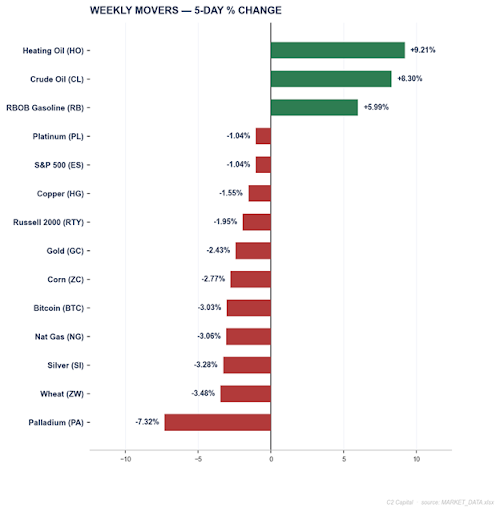
- This morning's August CPI is the week's central data point: core inflation ran hotter than expected (+0.3% m/m vs. +0.2% consensus, 2.4% y/y), and energy alone — up +2.1% m/m/+16.3% y/y on the Iran-driven oil spike — did over a third of the entire monthly gain. Several corroborating sources put CME FedWatch-tracked September hike odds at roughly 90% after the print.
- Crude (CLV26) crossed $100/bbl for the first time since May, printing a fresh 52-week high near $104.46 Thursday after the US destroyed five Iranian tankers (Sept 8) and Iran retaliated with the largest wave of shipping attacks since the war began (10 ships, Sept 9) — then round-tripped nearly $6 back to $98.48 Friday on reports Gulf states may meet Iran in Oman Monday.
- The entire Treasury curve is deeply oversold (RSI 24-38, ZT through ZB) heading into the September 15-16 FOMC. Before today, the Street was genuinely split — Bank of America, UBS, Deutsche Bank, and five other houses now expect at least one hike, while Goldman Sachs, Morgan Stanley, and J.P. Morgan's own research desk (distinct from J.P. Morgan Wealth Management, which already expects a hike) still lean toward holding.
- Bitcoin fell -3.03% to $77,740. The CLARITY Act's collapsing odds are real and worsening — Galaxy Digital now sees just 10% passage odds, down from 75% on May 22, ahead of Tuesday's Senate cloture vote — but multiple analysts attribute today's specific decline to the same hot-CPI shock hitting rates and gold: a $190 million long-liquidation cascade followed the release within the hour, not a CLARITY-specific headline.
Data as of September 11, 2026 at 11:30 am CT.
WEEK IN REVIEW: MACRO CONTEXT
The August CPI print connects every story in this issue. Headline inflation ran +0.4% month-over-month (3.4% year-over-year); core CPI ran +0.3% month-over-month (2.4% year-over-year) against a +0.2% consensus — a genuine, if modest, upside surprise. Energy inflation did the heavy lifting: the energy index rose +2.1% month-over-month and +16.3% year-over-year, with gasoline alone responsible for over a third of the entire monthly CPI gain, according to Bloomberg.
CME FedWatch-tracked odds of a September hike jumped to roughly 90% following the CPI release. The 10-year Treasury yield touched about 4.91% intraday, a post-October-2023 high, and hike odds this week moved unambiguously higher.
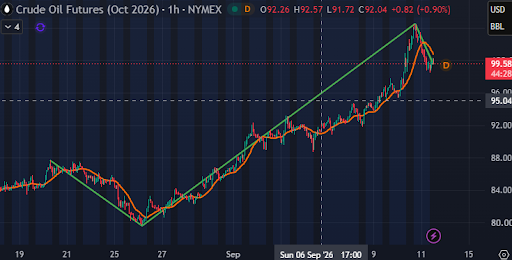
Crude oil delivered the week's most dramatic single-session move. WTI (CLV26) crossed $100 per barrel for the first time since May, extending a rally that began when US Central Command destroyed five Iranian tankers on September 8 — four in the Gulf of Oman, one near Kharg Island — in response to attempted Iranian ballistic-missile strikes on a US Navy warship. Iran retaliated September 9 with the largest wave of shipping attacks since the war began: ten ships struck near the Strait of Hormuz, plus a missile strike on the US base in Al-Azraq, Jordan. Crude printed a fresh 52-week high of $104.46 Thursday before completely reversing course Friday, falling to $98.48 and settling near $100.02 — a roughly $6 round trip in a single session — after Bloomberg and the Financial Times reported that Gulf Cooperation Council foreign ministers may meet Iran's foreign minister in Salalah, Oman on Monday, September 14 to discuss a temporary Hormuz shipping arrangement.
Notably, refined products did not follow crude's reversal: HOV26 and RBV26 both printed fresh 52-week highs the SAME session, confirming that the products rally is being driven by a structural refining-capacity shortfall independent of the crude-specific war premium, which can and did unwind quickly on a single diplomacy headline.
Rates and precious metals absorbed the same hawkish shock in lockstep. The entire Treasury curve is deeply oversold heading into next week's FOMC meeting — reflecting weeks of accumulating hawkish repricing that today's CPI print extended further.
Bitcoin (BTCU26) fell -3.03% to $77,740, and while the CLARITY Act's collapsing passage odds remain a genuine and worsening regulatory overhang, multiple analysts attribute today's specific decline mechanically to the same hot-CPI shock — a reported $190 million in long positions were liquidated within an hour of the release.
ENERGY (CLV26 / HOV26 / RBV26) — CRUDE CROSSES $100, THEN GIVES $6 BACK
Crude oil crossed the psychologically important $100-per-barrel level for the first time since May this week, and then delivered one of its sharpest single-session reversals of the year. Genuine, escalating military conflict drove the run-up.
Bloomberg and the Financial Times reported that Gulf Cooperation Council foreign ministers may meet Iran's foreign minister in Salalah, Oman on September 14, to discuss a temporary Hormuz shipping arrangement.
PRICE ACTION & TECHNICAL STRUCTURE
CLV26 traded a full range of $98.48 to $104.46 today alone — the high a fresh 52-week print — before settling at $100.02, up +8.30% (+$7.67) on the week. Mechanical profit-taking at the $100 round number compounded the reversal, though today's reversal warns that the trend's direction is no longer one-way.
Price remains above all four moving averages (MA20 $88.21, MA50 $82.07, MA100 $81.60, MA200 $73.49). Volume of 283,453 ran at 1.08x the 20-day average (263,164) — confirmed, above-average participation on a genuinely volatile week.
FUNDAMENTAL THESIS
Two genuinely separate forces are at work, and this week's price action is the cleanest possible illustration of why they should be sized differently.
The crude-specific war premium is real but headline-reversible: it can add $5-10 on an escalation and give most of it back on a single diplomacy report, exactly as happened this week.
The refined-products story, by contrast, is structural and has been intensifying for months: the diesel crack spread has been setting records through August and into September on a combination of a de facto partial Hormuz closure, roughly a quarter of Russian refining capacity lost to Ukrainian strikes in the first half of 2026, US refinery utilization maxed near 98%, and refiners tilting yield toward high-margin jet fuel at the expense of middle distillates just as heating-oil season begins.
NOTABLE POSITIONING & FLOW
General commentary confirms elevated options activity clustered around the $100 psychological level as crude approached and crossed it Thursday, consistent with round-number gamma effects.
CATALYST CALENDAR — NEXT 10 DAYS
WATCH ITEMS
- Monday's Oman meeting (primary): the single most important scheduled event for crude specifically — a confirmed framework, a collapse, or simply no agreement reached would each move price meaningfully in a different direction.
- Further military escalation: after two consecutive weeks of tanker strikes and missile exchanges, any repeat would extend crude’s premium regardless of the diplomatic track.
- Crack-spread durability: watch whether HOV26/RBV26 continue making fresh highs independent of crude’s direction — that divergence, if it persists, is the clearest confirmation the products trade is structural, not a crude-beta play.
RATES (ZT / ZF / ZN / ZB) — A HOT CPI TURNS ‘LIVE DEBATE’ INTO ‘BASE CASE’
The entire Treasury curve is deeply oversold heading into next week's FOMC meeting, and today's CPI print pushed the market a meaningful step closer to actually pricing a hike rather than merely debating one.
Going into Friday morning (pre-CPI report), the Street was genuinely split: a Reuters poll of 93 economists (September 4-9) showed roughly 70% still expecting a hold at next week's meeting — down sharply from 90% in the August poll — while a narrower primary-dealer survey put the full-year question at 11 firms expecting no hikes at all in 2026 versus 10 expecting at least one (plus Jefferies alone still expecting cuts).
Then August CPI printed hot: headline +0.4% month-over-month/3.4% year-over-year, core +0.3% month-over-month/2.4% year-over-year against a +0.2% consensus. CME FedWatch-tracked hike odds jumped to roughly 90% following the release
PRICE ACTION & TECHNICAL STRUCTURE
ZTZ26 (2-year) last traded 102-04, down -0.47% on the week, with RSI at 24.05 — deeply oversold — and ADX at 12.08.
ZFZ26 (5-year) fell -0.94%, printing a fresh 52-week low (104-12.5), RSI 25.17.
ZNZ26 (10-year) fell -1.18%, also a fresh 52-week low (105-29), RSI 28.54. ZBZ26 (30-year) fell -1.35%, within 0.8% of its own 52-week low (106-05), RSI 37.55 — the least oversold of the four, consistent with the long end absorbing less of this week's repricing than the front and belly of the curve.
FUNDAMENTAL THESIS
The bank-by-bank split into next week's decision is genuinely wide, and worth laying out in full because both sides have serious institutional weight behind them.
Analyst FOMC forecasts are all over the place!
On the hike side: Bank of America expects three consecutive 25bp hikes (September, October, December) to 4.25-4.50%, arguing that NOT hiking if core inflation stays sticky would itself raise questions about the Fed's commitment to its 2% target. UBS Global Wealth Management flipped to expecting hikes in September and December after the August jobs report and Chair Warsh's Jackson Hole remarks. Deutsche Bank, Barclays, and Wells Fargo Investment Institute each expect roughly two hikes; Société Générale sees three (September, December, and March 2027); J.P. Morgan Wealth Management has an explicit single September hike call; Macquarie moved its first hike forecast forward from December to September; and Capital Economics' actual base case — not merely a possibility — is a September hike.
On the hold side: Goldman Sachs (David Mericle) keeps a no-hike-in-2026 baseline with first cuts pushed to June and December 2027, though the desk has raised its subjective odds of a 2026 hike to 20% from 10%. Morgan Stanley's house view remains hold through 2026, with the hike/cut debate pushed into 2027, reportedly acknowledging the July meeting created more uncertainty about the Fed's reaction function than expected. J.P. Morgan's own research desk (Michael Feroli) — a distinct call from J.P. Morgan Wealth Management above — has a modal December hike with September as a genuine live risk. Citi, previously the Street's most dovish house, capitulated after the August jobs report and pushed its own rate-CUT call all the way out to mid-2027.
The Fed's own internal split: July's meeting was a 9-3 hold, with dissenters Beth Hammack (Cleveland), Neel Kashkari (Minneapolis), and Lorie Logan (Dallas) all favoring an immediate hike; minutes released August 19 noted non-voting presidents Jeffrey Schmid (Kansas City) and Alberto Musalem (St. Louis) would also have backed a hike had they held a vote that year.
CATALYST CALENDAR — NEXT 10 DAYS
WATCH ITEMS
- The dot plot, not just the rate decision (primary): per the user thesis this issue is built around, the Summary of Economic Projections may matter as much as whether the Fed hikes 25bp — a hold with a hawkish dot plot could hit the curve similarly to an actual hike.
- Warsh's characterization of today's CPI: whether he frames the energy-driven upside surprise as transitory (Iran-shock-specific) or as evidence of broadening price pressure will matter enormously for the post-meeting reaction.
- Oversold-bounce risk: RSI in the mid-20s across most of the curve means a dovish surprise could produce an outsized short-covering rally — this is not a one-way setup despite the clear directional pressure of the past month.
BITCOIN (BTCU26) — THE REGULATORY OVERHANG IS REAL, BUT TODAY IS A CPI STORY
Two distinct forces are pressuring Bitcoin right now, and this issue keeps them carefully separated rather than blending them into one narrative. The structural, worsening one is regulatory: Galaxy Digital has now cut its odds of CLARITY Act passage in 2026 to just 10%, down from 75% on May 22 — a collapse driven by unresolved ethics rules on federal officials' crypto holdings (a direct reference to the Trump family's crypto-venture exposure), banking-industry pressure over stablecoin yield provisions, unresolved DeFi developer-liability protections, and, per Galaxy's head of research, a Senate calendar compressed to roughly two to three weeks of real floor time once midterm politics take over.
Polymarket's own year-end passage contract has traded in the 14-19% range this week. Treasury
Secretary Bessent posted directly on X September 9, urging the Senate to ‘remain at the negotiating table, agree to the motion to proceed, and continue the legislative process,’ warning that inaction would signal America is ‘unwilling to lead on the future of digital assets.’
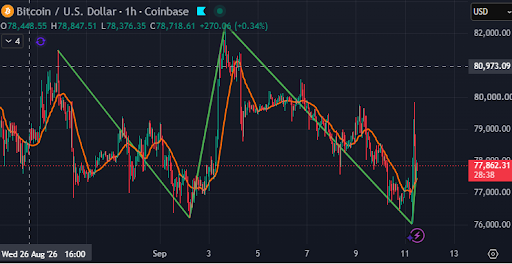
The tactical, immediate force is macro: BTCU26 fell -3.03% to $77,740 this week, and multiple outlets attribute today's specific move to the same hot-CPI/hawkish-repricing shock hitting rates and gold — a reported $190 million in long positions were liquidated within an hour of the release, with BTC falling roughly 2.2% Thursday alone on a hot PPI print that preceded today's CPI.
PRICE ACTION & TECHNICAL STRUCTURE
BTCU26 last traded $77,740, down -3.03% (-$2,429.12) for the week. Price remains above all key moving averages (MA20 $75,905, MA50 $69,116, MA100 $70,866, and roughly at MA200 $76,447) — this week's decline has not yet broken the broader technical structure built over the prior month. BTCU26 sits 41.7% below its 52-week high ($133,380, a prior-cycle peak) and well above its 52-week low ($58,380).
NOTABLE POSITIONING & FLOW
Deribit total BTC options open interest sits around $33.7 billion, concentrated in the September 25 expiry (~$14.4 billion) — the same date as CME's BTCU26 expiry, and landing 10 days after both the Senate vote and the FOMC decision, making it a major gamma date once both events have resolved. The 30-day implied volatility index (DVOL) was running around 39 this week, emerging off summer lows.
Options positioning commentary suggests longer-dated skew has been drifting toward put premium — consistent with hedging demand into the compressed Sept 15-16 event risk — though we could not confirm a precise, current skew reading to a verifiable standard and do not state one here.
CATALYST CALENDAR — NEXT 10 DAYS
WATCH ITEMS
- Tuesday's cloture vote (primary regulatory): watch specifically whether Gillibrand, Warner, or Warnock signal support in the days before the vote — that would be the leading indicator, well ahead of the vote itself.
- FOMC outcome (primary macro): given research shows BTC has repeatedly not cleanly priced the CLARITY odds collapse, the FOMC outcome is likely to be the larger near-term price driver of the two events landing next week.
- ETF flow continuation: confirmation of whether the 3-week inflow streak extended through this week's PPI/CPI shocks (data not yet available) would be an important read on whether institutional conviction is holding through the volatility.
IMPORTANT NOTICE — PLEASE READ CAREFULLY
This publication is for informational and educational purposes only and does not constitute investment advice, a recommendation, or an offer or solicitation to buy or sell any futures contract. Futures trading involves substantial risk of loss and is not appropriate for all investors; leverage can work against you as well as for you. Past performance is not indicative of future results. Per CFTC Rule 4.41, any hypothetical or simulated performance results have inherent limitations, do not represent actual trading, are prepared with the benefit of hindsight, and no representation is made that any account will achieve similar profits or losses.
Week 37: A Tanker War Reignites Crude, and the Fed's Coin Flip Lasted Exactly One Day
KEY TAKEAWAYS
- Crude's +8.50% five-day surge wasn't primarily about Iran's threatened Gulf "restricted zone" (still unannounced as of this writing) — it was a real weekend military escalation: Iran fired missiles at two US Navy warships Saturday, and US Central Command retaliated by disabling three Iranian tankers, including one near Kharg Island, Iran's main crude export hub. CLU26/CLV26 to $92.70-92.72, Brent to $93.33-93.36 (+5.86%).
- The diesel crack spread hit a NEW all-time record of $107.35/bbl on September 1 — up from the already-unprecedented $102.20 record in mid-August — confirming the structural refining-capacity story keeps intensifying independent of the crude headlines. HOV26 +6.51%, RBV26 +4.96% on the week.
- Copper's tariff-uncertainty story continues: US July imports hit a record 225,094 tons (not "200,000" as commonly cited), while Chilean guidance cuts from Antofagasta and Lundin Mining compound a tightening concentrate market — all while a US tariff decision that was due by a June 30 deadline remains unannounced with no fixed date. The LME cash contract hit a genuine all-time high ($14,830/t, Aug 17); the more widely quoted 3-month benchmark remains just below its own January record.
- Fed Governor Christopher Waller's dovish Wednesday remarks (Sept 3) briefly cut September hike odds to a coin flip and sent gold to its best day in weeks ($4,539.90). Then Friday's August jobs report — +162,000 vs. +55,000 expected, with July's stunning -23,000 miss revised all the way up to +21,000 — fully reversed the move: hike odds jumped back above 60%, the 2-year yield hit its highest level since January 2025, and gold gave back the entire Waller-day rally. One outlet's headline said it best: "Gold's Coin Flip Lasted a Day."
Data MIXED from holiday trade as of the close on Friday, Sept 4, and reopen Sunday, Sept. 6, 2026.
WEEK IN REVIEW: MACRO CONTEXT
The week’s dominant energy story is a real military escalation, not the headline everyone was watching for. Iran’s Supreme National Security Council previewed a new ‘restricted zone’ in the Gulf on Sunday, September 6 — but as of this writing it remains unannounced, with no maps or coordinates yet published.
What actually moved the tape was a weekend exchange: Iran fired missiles at two US Navy warships near the Strait on Saturday, and US Central Command retaliated by disabling three Iranian crude tankers, including one near Kharg Island — Iran’s main crude export hub, not just a Strait transit target. Iran claims to have struck three tankers and three US-linked vessels in response.
Refined products are telling a partly independent story. The diesel crack spread hit a NEW all-time record of $107.35 per barrel on September 1 — up from the already-unprecedented $102.20 record set in mid-August — as Russian refinery throughput remains roughly 30% below its 2016-2023 seasonal average from sustained Ukrainian drone strikes. HOV26 gained +6.51% and RBV26 gained +4.96% on the week, both riding the crude-driven war premium on top of that structural refining shortage.
The week’s cleanest story belongs to rates, and it’s a genuine round trip. Fed Governor Christopher Waller's Wednesday, September 3 remarks — saying he’d be ‘inclined to support holding’ rates if disinflation continues — sent September hike odds from the mid-60s down to a coin flip.
ENERGY (CLV26 / HOV26 / RBV26) — A REAL TANKER WAR, NOT JUST A THREATENED ZONE
The headline everyone was watching for this week — Iran’s promised new ‘restricted zone’ in the Gulf — still hasn’t actually arrived. Mohsen Rezaei, Secretary of Iran’s Supreme National Security Council, previewed the announcement in a Sunday, September 6 state TV interview, describing a zone that would run from the line of the existing US naval blockade toward the Strait of Hormuz and into parts of the Persian Gulf — but with no coordinates, no enforcement detail beyond ‘sanctions listing’ for vessels that enter, and no confirmation it has actually been published as of this writing.
What did happen, and what actually explains this week’s +8.50% crude surge, is considerably more concrete: Iran fired missiles at two US Navy warships near the Strait on Saturday, September 5, and US Central Command retaliated within hours, disabling three Iranian crude tankers — including one near Kharg Island, Iran’s primary crude export terminal, a direct hit on export infrastructure rather than just a Strait transit target. Iran claims to have struck three tankers and three US-linked vessels in retaliation. Separately, earlier in the week, Iran’s Revolutionary Guard said it disabled two tankers using sea mines. This is described by multiple outlets as the sharpest flare-up after a month-long lull.
PRICE ACTION & TECHNICAL STRUCTURE
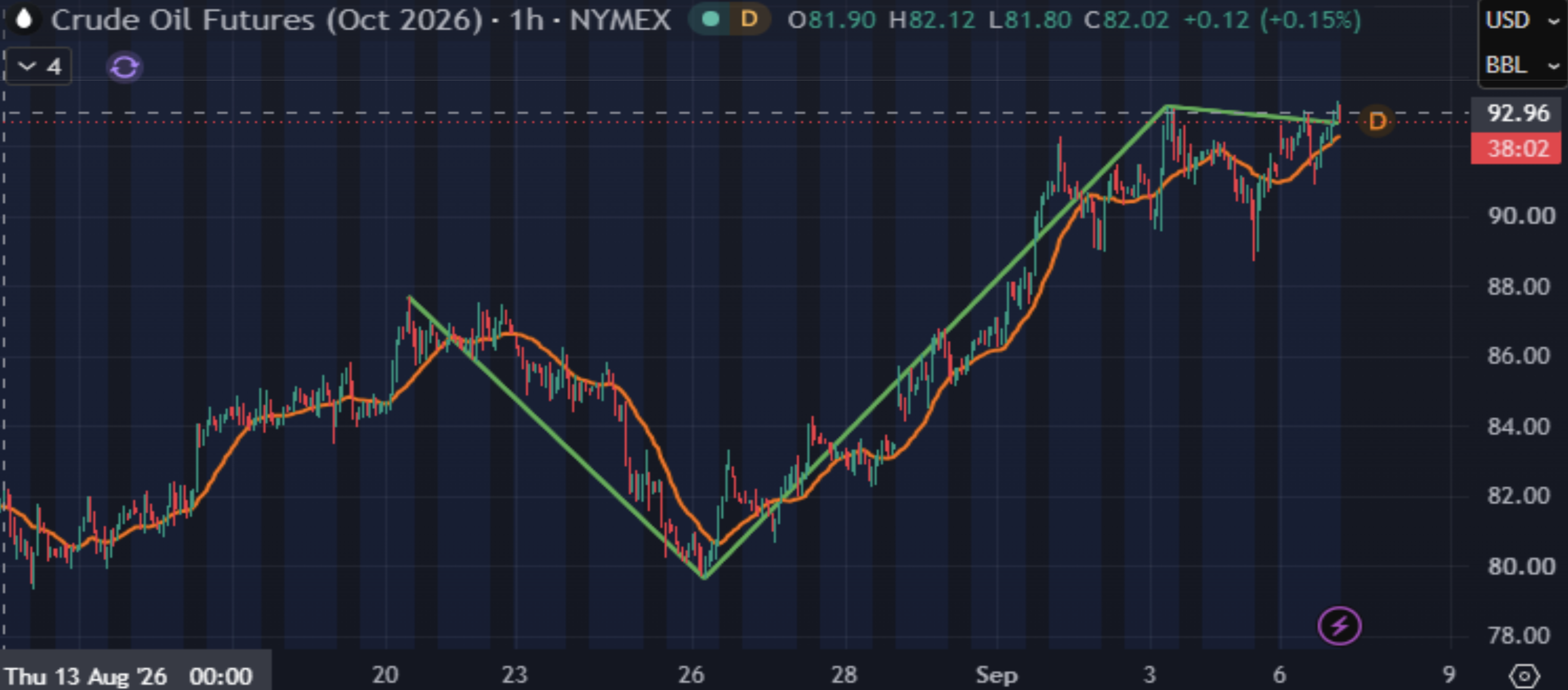
CLV26 (October WTI) last traded $92.70-92.72, up +8.50% over the past five trading days — also up +20.61% over the past month, +12.23% over three months, and +52.92% over the past year. Brent (QAZ26, December) last traded $93.33-93.36, up +5.86% on the week and +44.77% over 52 weeks.
HOV26 (October heating oil) last traded $4.6907-4.6923, up +6.51% on the week, +22.88% over one month, +35.62% over three months, and a striking +117.69% over 52 weeks (+128.79% year-to-date) — among the largest 52-week gains. RBV26 (October RBOB) last traded $3.2295-3.2299, up +4.96% on the week and +76.34% over 52 weeks. Both refined products continue to outgain crude on longer timeframes, consistent with a structural refining story layered on top of the crude-specific war premium.
CATALYST CALENDAR — NEXT 10 DAYS
WATCH ITEMS
- Formal announcement of Iran's restricted zone (with actual maps/coordinates) vs. a surprise signing of the competing Iran-Oman transit corridor — these are opposite-direction outcomes from the same broader negotiation, and only one has even been described as imminent.
- EIA report (Sept 10, primary): distillate stocks remain the key line item given the crack-spread story — a further draw would extend the record; a meaningful build would be the first real relief signal.
- Further tanker/naval incidents: any additional strike on export infrastructure (echoing the Kharg Island hit) would extend the crude premium; a quiet week would let the position drift back toward the pre-escalation range.
COPPER (HGZ26) — IT'S THE UNCERTAINTY, NOT THE TARIFF ITSELF
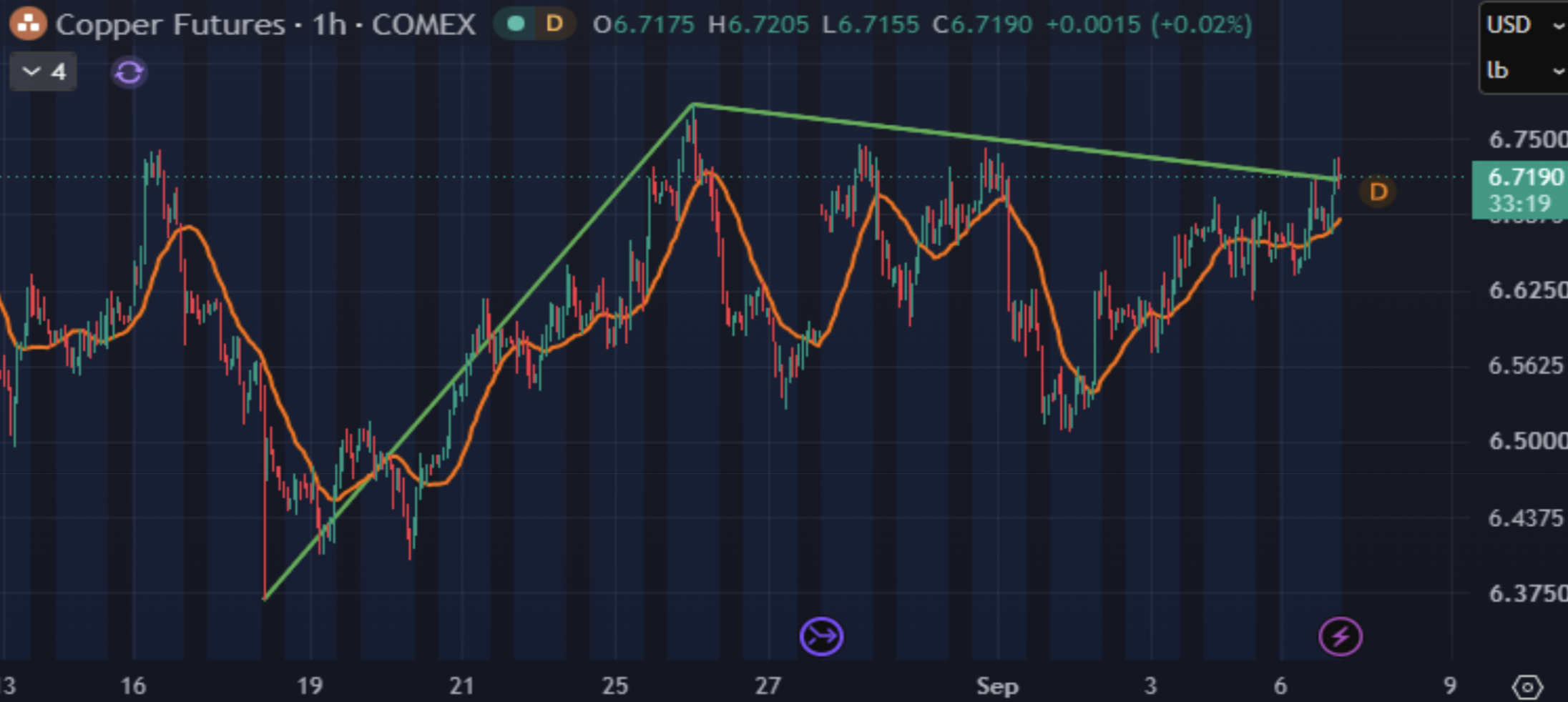
Copper had a quiet week in percentage terms — HGZ26 gained just +0.45% — but the underlying story remains one of the most closely watched structural setups in metals. The London Metal Exchange's cash (spot) copper contract hit a genuine all-time high of $14,830/t (Aug 17, 2026), driven by tightness in the nearby/prompt market (backwardation), while the more widely quoted 3-month benchmark contract has been trading roughly $14,310-14,450/t through late August — still just below its own all-time high of $14,527.50/t (Jan 29, 2026).
These are two different records on two different parts of the same curve, and this issue does not conflate them. US buyers continue pulling record volumes from the seaborne market: July refined copper and alloy imports hit 225,094 metric tons — the highest monthly total in Commerce Department records dating to 1990, and meaningfully above the commonly cited ‘200,000 tons’ figure — up 78% month-over-month and 8% year-over-year.
PRICE ACTION & TECHNICAL STRUCTURE
HGZ26 (December, front month) last traded $6.7180-6.7195, up +0.45% over five trading days but up a much larger +6.38% over one month, +41.97% over three months, +13.66% over 52 weeks, and +19.16% year-to-date — this week's modest move sits on top of a sustained multi-month structural rally rather than representing a new breakout on its own.
COMEX copper has been trading at roughly a $400-per-tonne premium to the LME benchmark, consistent with the well-documented US import surge described above; that spread remains well below the roughly $2,937-per-tonne peak reached in July 2025 during an earlier tariff scare, suggesting the market is currently pricing a contained or phased outcome rather than a hard binary shock.
FUNDAMENTAL THESIS
The core analytical insight worth featuring — credited to Rafael Barcellos, head of Latin American Metals & Mining and Pulp & Paper Equity Research at Bradesco BBI — is that market consensus frames the pending US tariff decision as a binary outcome (tariff = bullish, no tariff = bearish), but both outcomes are arguably bearish in isolation: if tariffs are not implemented, the massive inventories US buyers have already built would be redirected back into the global seaborne market, increasing supply availability outside the US; if tariffs ARE implemented, US buyers would likely reduce near-term procurement given the elevated stocks already on hand, reducing regional demand.
The more likely outcome — a phased tariff (one specific proposed framework: 15% starting January 2027, rising to 30% in January 2028, plus a 25% domestic-sales requirement for copper inputs) — would keep US buyers active in the seaborne market for longer, smoothing rather than removing the eventual demand adjustment. Notably, the original June 30 deadline for a Commerce Department determination has passed without any public presidential decision, and no new decision date has been announced — this remains an open-ended overhang, not a scheduled event.
CATALYST CALENDAR — NEXT 10 DAYS
WATCH ITEMS
- The tariff announcement itself (whenever it lands): per the Bradesco framework, watch for the market's reaction to diverge from the naive tariff-bullish/no-tariff-bearish framing — a phased outcome is the base case and would be the most consistent with current price action.
- China trade/demand data (Sept 8-10): confirmation that Chinese demand is improving alongside the PMI uptick would reinforce the structural bull case independent of the US tariff overhang.
- Further Chilean mine disruption: any additional weather-driven guidance cut would tighten the concentrate market further and could push the LME 3-month contract to a fresh all-time high.
RATES (ZT / ZN / ZB) — WALLER'S DOVISH WEDNESDAY, ERASED BY FRIDAY'S JOBS REPORT
This week is a clean round trip, and the two data points bracketing it are worth holding side by side. Fed Governor Christopher Waller spoke Wednesday, September 3, and while he acknowledged inflation remains ‘elevated significantly above’ the Fed's 2% goal, he highlighted that three-month inflation has fallen steadily from 4.76% in February and said explicitly: ‘If this continues in the data due over the next two weeks, I would be inclined to support holding the target for the federal funds rate’ — with an important conditional caveat that a hot print would change his view.
Markets read this as dovish: September hike odds fell from the mid-60s to roughly a coin flip, the Dollar Index dropped to a 1.5-week low (-0.67% on the day), and gold rallied to its best day in weeks.
Then Friday's August jobs report arrived and did the opposite: nonfarm payrolls rose +162,000 against a +55,000 consensus — the largest increase in five months — and July's stunning -23,000 miss (the figure that helped trigger the entire dovish repricing narrative two newsletter issues ago) was revised all the way up to a +21,000 gain. Hike odds snapped back above 60% within minutes of the release.
PRICE ACTION & TECHNICAL STRUCTURE
ZNZ26 (December 10-year, now front month) last traded 107-11 against a prior session close of 107-15, a -0.12% (session) move. The bigger tenor-specific story is in the reaction magnitude: the 10-year yield rose only 1-2 basis points on Friday to roughly 4.77-4.78% — described by one market recap as ‘surprisingly small given the data beat’ — after touching an intraday high near 4.82% on Tuesday and pulling back to roughly 4.74-4.76% on Wednesday/Thursday's dovish Waller remarks.
That pattern (up Tuesday, down Wed/Thu, partial unwind Friday) reads as the curve round-tripping back toward where it started, not establishing a fresh trend. The front end moved more: the 2-year yield rose roughly 5 basis points to about 4.39% on Friday, reportedly its highest level since January 2025 — consistent with the repricing being concentrated in near-term rate-path expectations rather than a broader growth or inflation regime shift.
FUNDAMENTAL THESIS
The next real test lands inside the Fed's traditional pre-meeting blackout period: August CPI releases September 11, just five days before the September 15-16 FOMC decision — directly answering the inflation-durability question Waller himself posed.
CATALYST CALENDAR — NEXT 10 DAYS
WATCH ITEMS
- August CPI (Sept 11, primary): the single data point standing between now and the FOMC decision — directly tests the disinflation trend both Waller and Warsh have staked their competing framings on.
- Front-end vs. long-end divergence: the 2-year's sharper reaction (new 18-month high) versus the 10-year's muted response suggests the market currently sees this as a near-term rate-path question, not a durable inflation regime shift — watch whether that divergence holds or the long end starts moving in sympathy.
- FOMC meeting (Sept 15-16): full resolution of the multi-week Warsh-hawkish/Waller-dovish tension that has now spanned three consecutive newsletter issues.
Week 36: Wheat Explodes, the Fed Turns Hawkish, and Bitcoin Shrugs It Off
KEY TAKEAWAYS
- Wheat had its loudest week of the year: Bloomberg reported mid-week that Russia is preparing to escalate strikes on Ukraine after peace talks stalled, sending CBOT wheat limit-up on top of an already-tightening Black Sea picture (the mid-August Novorossiysk strike had taken over 90% of Russia's Azov-Black Sea grain export capacity offline). ZWZ26 +12.94% to 783.50¢ (0.8% below a fresh 52-week high), KEZ26 +10.19% to 847.00¢ (a fresh 52-week high). Corn (+6.10%) and soybean meal (+7.64%) each have independent bull cases — falling crop ratings and a record-crush/biofuel-mandate story — reinforced by broad fund short-covering across the complex, not pure sympathy buying.
- Fed Chair Kevin Warsh's first Jackson Hole keynote as chair reaffirmed the 2% PCE target as ‘firm, fixed’ and said summer inflation improvement doesn't mean underlying trends have changed — sending September rate-hike odds from roughly one-third to a genuine ‘coin flip’ (trackers show roughly 46-61%) and the 2-year yield up 9-12 basis points to a one-month high. But the 30-year actually gained +0.69% on the week — a real bear-flattening, with the long end technically supported by the September 9 Treasury buyback expansion even as the front end repriced hawkish.
- Bitcoin (BTCQ26) held its ground: +2.48% further to $79,095, oscillating around the psychological $80,000 level all week (first reclaimed Tuesday, a three-month high) and dipping only modestly on the Warsh headline itself — one outlet called it ‘modest... not a reversal.’ Spot ETF inflows ran nine consecutive days through Thursday, the strongest August on record for the category.
- Gold and silver pulled back from three-month highs — the textbook hawkish-Fed reaction, though the retreat from gold's $4,696-4,697 Tuesday peak actually began on dollar strength and profit-taking before Warsh even spoke; his keynote added a confirming leg down. GC -3.03% to $4,480.70, SI -3.35% to $67.00.
Data as of August 28, 2026, at 11:55 am CT
WEEK IN REVIEW: MACRO CONTEXT
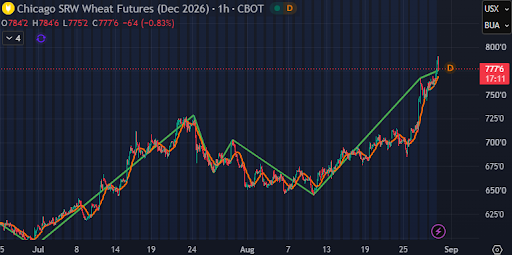
The loudest story of the week arrived without warning: Bloomberg reported mid-week that Russia is preparing to escalate strikes on Ukraine, including infrastructure, after peace talks broke down — CBOT wheat went limit-up on the headline, with KC and Minneapolis wheat following. This builds directly on the Black Sea supply shock already underway since mid-August, when a Ukrainian drone strike on Russia's Novorossiysk port took more than 90% of Russia's Azov-Black Sea grain export capacity offline. ZWZ26 gained +12.94% to 783.50¢, sitting just 0.8% below a fresh 52-week high; KEZ26 gained +10.19% to 847.00¢, printing a fresh 52-week high outright.
Rates delivered the week's cleanest macro signal. Fed Chair Kevin Warsh delivered his first Jackson Hole keynote as chair Friday morning, reaffirming the 2% PCE inflation target as ‘firm, fixed’ and cautioning that while summer inflation readings were better than expected, they ‘do not tell me that underlying trends have meaningfully improved’ — otherwise, he said, ‘we have work to do.’ He noted 54% of PCE basket components are still showing greater than 3% annual price increases, and that he would be ‘hard pressed to describe broad financial conditions as restrictive.’
Bitcoin and precious metals — last week's twin ‘debasement trade’ winners — diverged this week under the same hawkish pressure. BTCQ26 gained a further +2.48% to $79,095, first reclaiming the psychological $80,000 level Tuesday (a three-month high) and spending the rest of the week oscillating around it; its dip on today's Warsh headline.
Gold, by contrast, peaked Tuesday at $4,696-4,697 (its highest since mid-May) before a pullback that began on dollar strength and profit-taking — not the Warsh speech itself, which landed two days later.
WHEAT COMPLEX (ZWZ26 / KEZ26) — RUSSIA SIGNALS ESCALATION AS PEACE TALKS STALL
Wheat had its loudest week since this newsletter began tracking the Black Sea story, and the trigger was new: Bloomberg reported mid-week that Russia is preparing to escalate strikes on Ukraine, including infrastructure targets, after peace talks broke down. CBOT December wheat went limit-up on the headline; KC and Minneapolis wheat followed with double-digit-cent gains the same session. This lands on top of an already-tightening picture: the mid-August Ukrainian drone strike on Russia's Novorossiysk port took more than 90% of Russia's Azov-Black Sea grain export capacity offline, three of the port's largest grain terminals halted operations, and SovEcon has cut its August Russian wheat export forecast to just 3.0-3.4 million tons — a potential decade low.
PRICE ACTION & TECHNICAL STRUCTURE
ZWZ26 last traded 783.50¢, up +12.94% (+89.77¢) on the week. RSI at 79.79 is extremely overbought, and ADX at 40.18 confirms one of the strongest trend readings in this newsletter's history — price is above all four moving averages (MA20 690.00¢, MA50 668.00¢, MA100 658.88¢, MA200 627.63¢) and has decisively cleared resistance (771.88¢), which now serves as first support.
KEZ26 shows an even sharper picture: last 847.00¢ (+10.19%, +78.33¢), RSI 76.12, ADX 36.27, printing a fresh 52-week high outright and trading above all four MAs (MA20 760.00¢, MA50 721.88¢). Both contracts are extremely overbought by conventional measures (RSI above 75-80), which raises genuine mean-reversion risk independent of any new headline — a factor addressed directly in the setup summary below.
Source: TradingView
FUNDAMENTAL THESIS
Wheat is the epicenter of a genuine two-exporter supply shock, and this week's move is not a technical artifact. Managed money was still net short roughly 25,300 SRW wheat contracts as of the most recent COT report (widened from about 20,000 the week prior) — meaning this week's breakout ran directly into a crowded short base, with an estimated 18,000 contracts of short-covering and fresh momentum buying added during the move. Demand confirms the tightening: US wheat export sales for the week ended August 20 hit a nine-week high (402,500 metric tons), and Egypt — the world's largest wheat importer — bought two cargoes of French wheat this week, a sign of import urgency amid the Black Sea disruption.
Importantly, this is not a pure wheat story bleeding into the rest of the grain complex by sympathy alone: corn's own good-to-excellent rating fell to 57% (down 3 points on the week, continuing a multi-week decline), and the Pro Farmer Crop Tour confirmed a national corn crop below last year's record with shorter grain fill than initial appearances suggested.
CATALYST CALENDAR — NEXT 10 DAYS
WATCH ITEMS
- Overbought unwind risk (primary): RSI above 75 on both ZW and KE, with a meaningful share of this week's gain attributable to short-covering rather than new conviction, means a sharp mean-reversion pullback is a live risk independent of any new headline — size positions accordingly.
- Confirmed new strikes vs. a return to negotiations: Fresh attacks on either side's grain infrastructure would extend the move; any surprise return to talks would risk unwinding a large share of this week's gain given how crowded the move already is.
- September 11 WASDE approaching: the next binary supply/demand re-estimate — begin reducing grain exposure per standing policy in the 24 hours prior.
RATES (ZTU26 / ZBU26) — WARSH BEAR-FLATTENS THE CURVE AT JACKSON HOLE
Fed Chair Kevin Warsh delivered his first Jackson Hole keynote as chair Friday morning, and the market's reaction was a clean, textbook front-end selloff — layered on top of a long end that is actually being held up by a separate, unrelated force.
Warsh reaffirmed the Fed's 2% PCE inflation target as ‘firm, fixed,’ noted that 54% of PCE basket components are still showing greater than 3% annual price increases, and said that while summer inflation data came in better than expected, it does not ‘tell me that underlying trends have meaningfully improved’ — otherwise, ‘we have work to do.’
He also said he'd be ‘hard pressed to describe broad financial conditions as restrictive’ and confirmed that at the July meeting a ‘good majority’ of the Committee favored waiting before changing rates. The reaction was immediate:
September rate-hike odds, which sat around one-third before the speech, jumped to a genuine coin flip — trackers (CME FedWatch, Kalshi, Polymarket) cluster in the 46-61% range afterward.
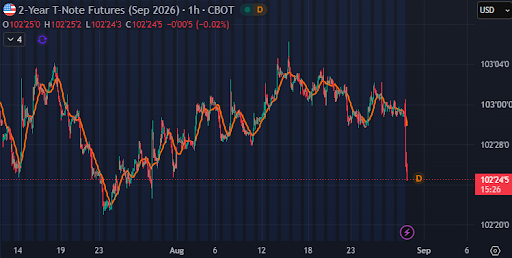
ZTU26 (2-year) fell -0.16% on the week and the underlying 2-year yield jumped roughly 11 basis points to a one-month high near 4.35%. Yet ZBU26 (30-year) actually gained +0.69% — a genuine bear-flattening of the curve.

Source: CME Group Fedwatch
PRICE ACTION & TECHNICAL STRUCTURE
ZTU26 last traded 102-25, down -0.16% on the week, with RSI at 38.61 reflecting the sharpest weakness in this issue's rates coverage; the contract sits within 1.9% of its 52-week high (104-25) and close to its 52-week low (102-21) — a genuinely compressed range for the front end.
ZFU26 (5-year) fell -0.23%, printing a fresh 52-week low (105-27.5), RSI 39.38.
ZNU26 (10-year) fell a smaller -0.12%, also a fresh 52-week low (107-31.5), with RSI 42.23 — the smaller decline relative to the 5-year, despite the longer duration, suggests the long-end support (discussed below) is already partially offsetting the hawkish repricing even at the 10-year point.
FUNDAMENTAL THESIS
The front end is repricing for a Fed that just signaled more hawkishness than the market expected: beyond Warsh's own remarks, Kansas City Fed President Jeff Schmid said current policy may be ‘accommodative on the short end’ with work left to do; Cleveland Fed President Beth Hammack — notably one of three dissenters who favored an immediate hike at the July meeting — reaffirmed the need for immediate action; Chicago Fed President Austan Goolsbee, while noting three-month inflation prints ‘don't look terrible,’ stopped short of endorsing a pause; and Boston Fed President Susan Collins had separately reiterated a ‘mildly restrictive’ stance days earlier.
The long end is being held up by an entirely different, technical force: the Treasury's August 19 announcement that it will at least double long-end liquidity-support buybacks (to $4 billion-plus per operation, 10-20Y and 20-30Y sectors) takes effect September 9, and the anticipation of that operation is providing a standing technical bid for the 20-30 year sector even as rate-path expectations sour. One counterpoint worth noting for balance: a Schwab strategist has publicly expressed skepticism that the buyback provides more than temporary relief once it actually starts, since it manages duration supply rather than reducing the total debt float — the long-end support could prove less durable than this week's price action suggests.
CATALYST CALENDAR — NEXT 10 DAYS
WATCH ITEMS
- September 4 NFP (primary): The next real-time labor read after last month's miss — a weak print would revive rate-cut odds and could unwind a meaningful share of this week's front-end selloff; a strong print reinforces the hawkish repricing into the FOMC meeting.
- September 9 buyback operations actually begin: This is the moment the long end's anticipated technical support becomes real — watch whether ZB holds its gains once the buying starts, or whether the ‘sell the news’ pattern from the original August 19 announcement (which also round-tripped within days) repeats.
- FOMC meeting (Sept 15-16): The actual decision — now genuinely uncertain per multiple trackers — will resolve the entire front-end repricing one way or the other.
BITCOIN (BTCQ26) — HOLDS $79-80K THROUGH A HAWKISH FED SURPRISE
Bitcoin's story this week is resilience, not a fresh breakout. BTCQ26 gained a further +2.48% to $79,095, extending last week's massive +22.73% surge into a consolidation around the psychological $80,000 level — first reclaimed Tuesday, August 25 (a three-month high, briefly touching $81,257 intraday), then spent the rest of the week oscillating in a $78,800-$81,282 band.
Today's hawkish Warsh keynote — which sent September rate-hike odds to a coin flip and pressured gold further — pulled Bitcoin modestly below $80,000, but one financial outlet described the move explicitly as ‘modest... not a reversal of the broader crypto rebound.’ That's the notable divergence this week: the same hawkish catalyst that extended gold's multi-day slide barely dented Bitcoin's hold on its recent gains. This contract (BTCQ26) expires today; volume of just 723 against a 20-day average of 10,180 reflects standard pre-expiry migration into the September contract, not a liquidity concern in Bitcoin itself.
PRICE ACTION & TECHNICAL STRUCTURE
BTCQ26 last traded $79,095, up +2.48% (+$1,914.09) on the week, with price well above all key moving averages (MA20 $69,206, MA50 $65,766, MA100 $70,328). Support now sits at $78,642, resistance at $81,002 — both already cleared and re-tested multiple times this week. BTCQ26 sits 6.0% below its 52-week high ($84,165).
WATCH ITEMS
WATCH ITEMS
- ETF inflow streak: A break in the nine-day (now potentially longer) positive streak would be the first sign institutional conviction is fading behind the price action — the single most important flow signal to track into next week.
- September 15-16 compression: The FOMC decision and the CLARITY Act cloture vote land the same week — a genuinely compressed, high-volatility window worth planning around well in advance.
- Overbought unwind risk: RSI at 77 after two strong weeks means a mean-reversion pullback remains a live risk independent of any new catalyst.
PRECIOUS METALS (GCU26 / SIU26) — PULLBACK FROM 3-MONTH HIGHS, THEN WARSH CONFIRMS IT
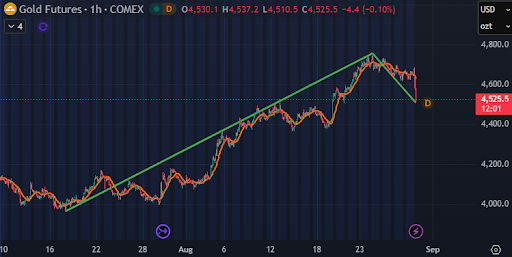
Gold and silver gave back a meaningful share of their recent run this week, and the sequencing matters: the pullback began Tuesday-Thursday on dollar strength and profit-taking after gold's parabolic run touched $4,696-4,697 intraday Tuesday, August 25 — its highest level since mid-May and, per one forecaster, potentially gold's strongest monthly gain since September 1999 (August's gain exceeded 15%).
Today's hawkish Warsh keynote arrived two days later and added a confirming leg down, not the initial trigger — the Dollar Index rose to roughly 99.50-99.59 on the speech and the 2-year yield spiked, both classic headwinds for a non-yielding asset like gold. GCU26 settled the week -3.03% to $4,480.70; SIU26 fell -3.35% to $67.00, both now trading below the support levels that had defined their prior breakouts.
PRICE ACTION & TECHNICAL STRUCTURE
GCU26 last traded $4,480.70, down -3.03% (-$140.01) on the week. Price remains above MA20 ($4,419.10) and just above MA100 ($4,427.10) but below MA200 ($4,593.10); critically, price is now BELOW its prior support level ($4,569.50), meaning that level has broken and become resistance on any bounce attempt, with $4,647.50 the next resistance above.
SIU26 shows the same pattern: last $67.00, down -3.35% (-$2.32) from a prior settle of $69.43, RSI 56.56, now trading below its own former support ($68.10).
Both metals remain well above their 20-day moving averages and far above their 52-week lows, so this reads as a genuine but not yet structural pullback within an intact intermediate uptrend.
WATCH ITEMS
- September 4 NFP (primary): A weak print would revive the same dollar-weakness narrative that drove last week's rally and could stabilize this pullback; a strong print extends the hawkish headwind into the FOMC meeting.
- Former support as new resistance: Watch whether GC and SI can reclaim their broken support levels on any bounce — failure to do so would confirm a more meaningful range reset rather than a shallow pullback.
- PBOC August data (~Sept 7): Confirmation that the central-bank buying streak continued would reinforce the structural bull case underneath this week's tactical pullback.
IMPORTANT NOTICE — PLEASE READ CAREFULLY.
This publication is for informational and educational purposes only and does not constitute investment advice, a recommendation, or an offer or solicitation to buy or sell any futures contract. Futures trading involves substantial risk of loss and is not appropriate for all investors; leverage can work against you as well as for you. Past performance is not indicative of future results. Per CFTC Rule 4.41, any hypothetical or simulated performance results have inherent limitations, do not represent actual trading, are prepared with the benefit of hindsight, and no representation is made that any account will achieve similar profits or losses.