

Highlights
- Trading journals reveal patterns in behavior, emotions, and risk that Profit & Loss can’t show.
- Successful traders use journaling to turn emotional reactions into data-driven insights.
- Topstep’s dual journal system tracks both emotional and analytical performance.
- Reviewing trades builds self-awareness, accountability, and long-term trading consistency.
- A trade journal acts as a compass, guiding traders toward smarter decisions and steady growth.
On the list of exciting new tools that can take your trading to the next level, a journal probably doesn’t make the cut. But the traders who keep one know something others don’t. It’s bigger than a journal to jot down thoughts in; it’s about direction. Think of it like a compass, pointing you to true north when market turbulence threatens to spin you in circles.
Without a compass, a path can feel right and still lead you right to a cliff. In trading, that cliff is drawdown, emotions, and slow leaks that don’t show up until it’s too late. You might think you’re winning without it, but you could be missing the signs that would lead to real success.
If you’re reading this, you may have reached the point where you realize the next step in your trading won’t come from another indicator or strategy. It will come from understanding yourself: your emotions, your reactions, and how they show up in your trades. It’s all connected, so let’s break down the value of the Trading Journal you’re missing out on before it costs you big.
The danger of flying blind
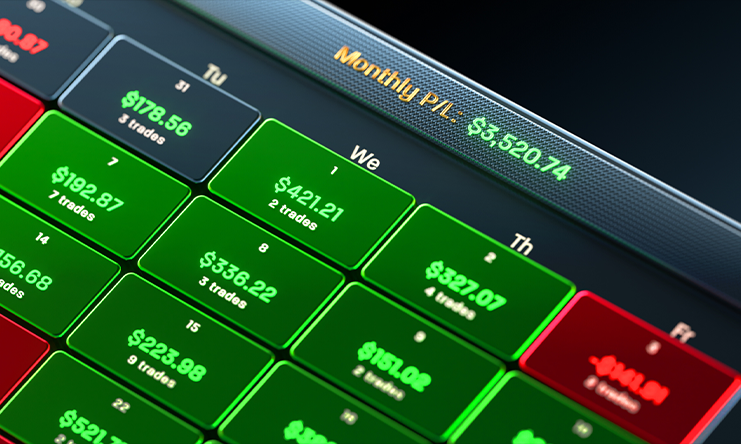
Picture this: You’ve got eight winning days in a row, confidence is through the roof (good job, by the way). The market feels predictable, almost easy. Then, suddenly, you lose your entire account on day nine. Sound impossible? It happens more often than you think.
You can have eight green days in a row and still be one bad decision away from losing your account. Maybe you’ve been racking up small wins, feeling more confident, and sizing up. Even on a few of those winning days, your trades went against you before turning around. It worked out, so you brushed it off. But those moments matter. They’re the ones quietly shaping your risk habits.
Then day nine hits. You size up again, the market moves fast, and one quick loss wipes out everything. Account blown.
A trading journal could have caught it before it happened. It would have shown how your risk crept up, how emotion started driving trade size, and how misleading those “green” days really were. Because not every green day is a good day, and not every red day is a bad one. The difference is knowing why.
This is why relying only on your Profit & Loss (P&L) as your “north star” can be dangerous. Your P&L might show green for weeks, creating a false sense of security and masking the problems in your approach. Many experience this rollercoaster and don’t realize they’re taking excessive risks or violating their own rules until it’s too late.
There are millionaire traders with 30% win rates, and there are broke traders with 80% win rates. It’s not about being “right” more often – it’s about knowing what you’re seeing when you see it and how you’re likely to handle it. Without a trading journal documenting your decision-making process, emotions, and market analysis, you’re pretty much trading blind, unable to tell what is for sure a good day and a bad day in the market.
When “good trading days” aren’t actually good
Speaking of, what is a successful trading day? If your answer is counting winning trades, you’re missing a piece of the puzzle. If you take three trades and win two of them, it sounds like a good day, right? But what if those two wins were down 50% before coming back to just above breakeven, while one loss wiped out a week’s worth of gains?
This approach is unsustainable because it focuses on the outcome instead of the process. You can actually lose money and still have what can be considered a great trading day, but you’d only know for sure if you’re tracking the right metrics. Moments where you follow your trading plan perfectly, manage risk appropriately, and make sound decisions based on your analysis. The market simply moved against you, which is part of the game.
But without proper documentation, you’d never know for sure. You’re missing out on the information that makes the difference.
Emotional intelligence in trading
Trading is fundamentally a psychological game, and your emotions are either your greatest asset or your biggest liability. A comprehensive trading journal tracks not just what you did, but how you felt before, during, and after each trade.
This emotional data reveals trigger patterns that might be sabotaging your performance. Did you notice that you tend to overtrade after a big winner? Or that you hesitate to take valid setups after a loss? A trading journal could reveal that. The most successful traders aren’t robots; they’re emotionally aware pros who understand their psychological patterns and plan accordingly.
Trading without a journal is like trying to improve your fitness without tracking your workouts. When you’re required to write down why you entered a trade, what your exit strategy was, and how you might’ve felt during the process, it becomes much harder to make impulsive decisions. Knowing you’ll need to explain your reasoning later creates a psychological barrier against emotional trading. That’s how winners make the right move: they hold themselves accountable for the losses.
How topstep’s dual trading journal system works
Topstep was built by Traders who know how brutal facing your results (and your emotions) can be, and built a dual-journal approach that addresses both the analytical and emotional aspects of trading. Offering traders one approach for your emotions and another for your data recognizes that successful trading usually needs both objective data analysis and subjective self-awareness.
The (built-in) Topstep Trading Journal:
- Automatically captures trade data, including entry/exit points, position sizes, profit/loss, and timestamps.
- Assigns a unique tracking number to each trade for in-depth analysis and market condition comparison.
- Removes the hassle of manual entry, keeping your records consistent and accurate.
This eliminates the drag of manual data entry that prevents traders from keeping consistent records.
And the second part is Topstep’s Emotional Journal. This system:
- Asks you to reflect on your mental state and decision-making for every trade.
- Let’s you link specific trades to your emotional notes using the trade number.
- Builds a more complete picture of your trading performance by comparing your results and your emotions.
The magic is how the two journals connect the dots between your emotional state and your trading results. You can use them separately if you need one more than the other, but using them together? You can discover that certain market conditions trigger emotional responses that can hurt your performance. Or, like trading pro (and Topstep legend) Hoag in the video below, you’ll find out that you make your best trades when you’re a little nervous.
“The trades that made me the most nervous end up being the trades that had a higher probability of success.” – Hoag
Your trading compass points to success
Your trading journal isn’t just a record of your past – it’s a roadmap to your future success. Wouldn’t you want concrete evidence of what’s working and why, instead of wondering if your latest win was skill or luck? With Topstep’s approach, you have access to tools pros use (for free!) to navigate the markets with confidence, knowing that every trade contributes to your growth as a trader, regardless of the outcome.
The compass is in your hands; now it’s time to use it to find your direction in the markets.
Frequently asked questions
How does a trading journal improve trade analysis?
A trading journal helps you review each trade objectively by tracking entry points, exits, position size, and emotional state. Over time, these insights reveal patterns in your decision-making and highlight areas for improvement in your trade analysis.
Can journaling strengthen my trading strategy?
Yes. By reviewing your past trades, a journal helps you identify which setups consistently perform best in different market conditions, allowing you to strengthen your trading strategy and eliminate ineffective habits.
How does a trading journal adapt to different trading styles?
Whether you’re a day trader, swing trader, or scalper, a trading journal helps tailor your approach to your unique trading style by showing what works best for your pace, risk tolerance, and time frame.
What role does a journal play in risk management?
A journal makes it easy to track drawdowns, win/loss ratios, and position sizes, giving you a clear picture of how well you’re managing risk. It helps prevent overexposure and keeps your trades aligned with your long-term goals.
Why is journaling valuable in understanding financial markets?
Tracking trades and emotions alongside market conditions helps you recognize how external factors in the financial markets influence your performance, leading to more informed, data-driven trading decisions.